AI Hard Mode: How to Orchestrate 9 Geniuses to Solve Complex Problems
You probably use Artificial Intelligence for quick questions or writing emails. That’s the “basic level.” It’s like having a Ferrari and only using first gear to drive to the bakery.
In this article, I’ll show you what happens when you take your use of Artificial Intelligence to the advanced level. I’ll explain how I orchestrated a “virtual board of directors” to design a complete business model in just a few hours, using the 9 Minds framework.
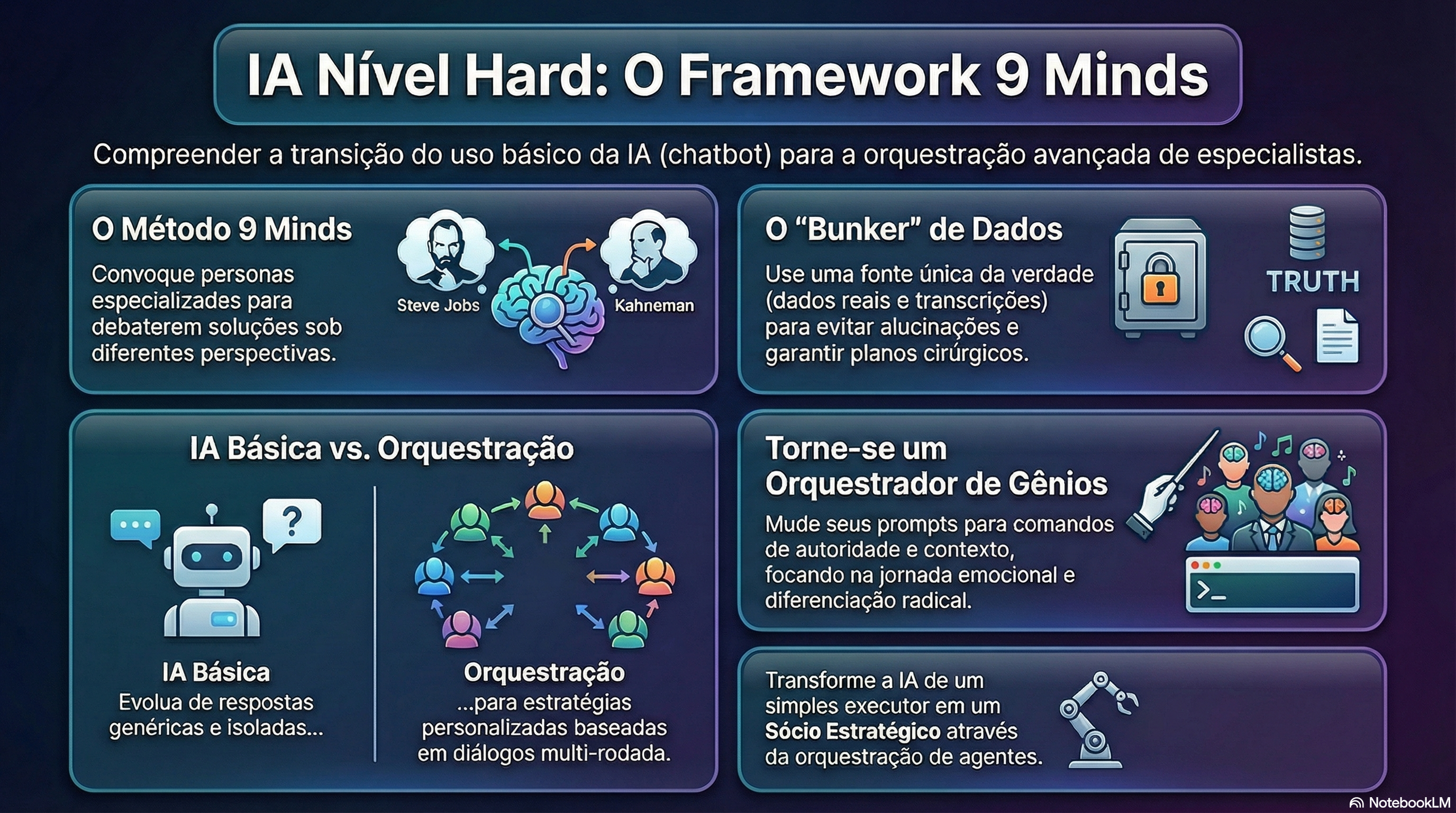
AI is not a search engine, it’s a Strategic Partner
The biggest mistake when starting with AI is treating it like a “better Google.” In advanced AI orchestration, we don’t just “ask questions” — we build a collaboration environment between autonomous agents.
Imagine you want to open a tech-forward coffee shop chain. Instead of asking “how to open a coffee shop?”, you create a Multi-round Research and Critique process, where different specialized AIs debate the viability of your project.
The 9 Minds Method (9 Minds Framework)
For my project today, I “summoned” a board of experts to debate the strategy:
- Steve Jobs: Demanded radical simplicity in the coffee shop app design. “Fewer screens, more experience.”
- Daniel Kahneman (Nobel Prize in Economics): Explained the psychological triggers that ensure customer retention (Behavioral Economics).
- Marty Cagan: Validated whether the product actually solved a real market pain point or was just an unfounded idea.
While they debated, Sub-agents researched commercial locations, analyzed bean logistics, and verified the legal viability of contracts.
The “Bunker” Concept (Source of Truth)
One of AI’s biggest challenges is “hallucination” (when it makes up facts). At the advanced level, we solve this with the Bunker (Single Source of Truth).
We take raw data — meeting transcripts, voice notes, and real research — and transform it into a master document. The AI is forbidden from making decisions outside this “Source of Truth.” This turns chaos into a surgical execution plan.
Comparison: Basic AI vs. Advanced AI
| Feature | Basic AI (Chatbot) | Advanced AI (Orchestration) |
|---|---|---|
| Interaction | Simple Question and Answer | Multi-round critical dialogue |
| Context | Limited to what you type | Based on a “Bunker” of real data |
| Execution | Isolated texts | Scripts, market analyses, and action plans |
| Result | Generic suggestions | Personalized and actionable strategy |
How can you start using AI like this?
To move beyond the basics and boost your productivity with AI, change your “Prompt” into a command of Authority and Context:
Advanced Prompt Example:
“Act as a board made up of Seth Godin and Steve Jobs. Debate among yourselves how to transform an ordinary coffee shop into an iconic object of desire. Focus on radical differentiation and the customer’s emotional journey. At the end, present a 3-step plan.”
Advanced AI doesn’t replace your intelligence; it amplifies it. You stop being a simple task executor and become the Genius Orchestrator.
FAQ: Frequently Asked Questions about Advanced AI
What is the 9 Minds Framework?
It’s an orchestration technique where different AI personas (specialists) analyze the same problem from distinct perspectives, generating a much more robust solution.
What are Autonomous Agents?
They are AI programs configured to execute specific tasks (such as research or coding) independently, reporting results back to the orchestrator.
How does Gemini CLI help in this process?
Tools like Gemini CLI allow developers and managers to integrate AI directly into their workflow, automating document creation and system command execution securely.
Enjoyed this behind-the-scenes look? In the next post, I’ll show how the technology behind this is changing the game for small and medium-sized entrepreneurs.